2026 Top French Doors Patio Doors for Global Buyers?
Choosing the right French Doors Patio Doors in 2026 requires more than comparing photographs and prices. Global buyers must examine climate, opening size, glazing, security hardware, drainage, and installation support. A beautiful door can still perform poorly in heavy rain or strong sunlight.
Gary Katz, a veteran door and window installation educator, puts it plainly: “A door is only as good as its installation.” That warning matters. Even a high-quality frame may leak when the sill is poorly supported or the surrounding wall is unprepared. Buyers should request tested performance data, warranty conditions, replacement-part availability, and clear technical drawings. These details often reveal more than a polished product page.
This guide introduces leading French Doors Patio Doors for international projects, including timber, aluminium, fiberglass, and composite options. It considers thermal efficiency, ventilation, accessibility, visual proportion, and long-term maintenance. Coastal homes may need corrosion-resistant hardware. Cold regions may require low-e glass and insulated frames. Humid climates deserve careful attention to drainage.
There is no universal winner.
A lower-priced model may offer attractive savings, yet installation costs can rise quickly. A premium system may deliver smoother operation, but its parts may be difficult to source overseas. Buyers should measure twice, compare honestly, and question assumptions. The best choice balances design, climate resistance, serviceability, and dependable local installation.
French Door Patio Doors: Definition, Structure, and Main Types
French Door Patio Doors: Definition, Structure, and Main Types
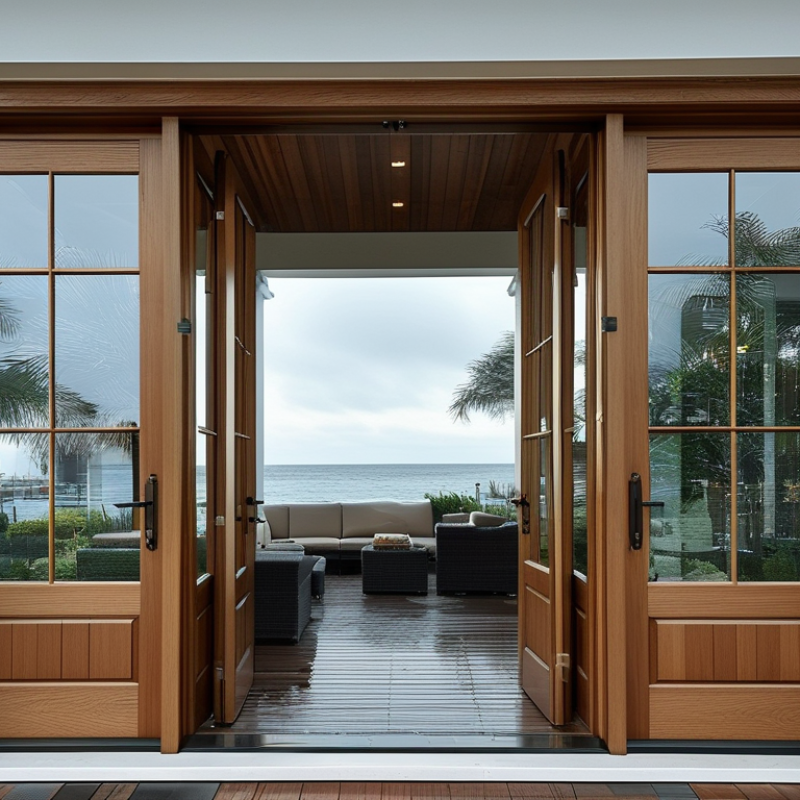
French door patio doors are hinged exterior doors with two leaves meeting at the center. Unlike a single patio door, they create a wider opening without a permanent central post. Their structure usually includes a frame, hinges, insulated glass panels, a sill, weather seals, and a multi-point locking system. The meeting section needs precise alignment. Small gaps there can cause drafts, rain entry, or difficult locking.
The main types include inswing and outswing French doors. Inswing models are easier to protect from exterior weather, but they require indoor clearance for furniture. Outswing models save interior space, yet their hinges and threshold need stronger weather protection. Door leaves may be equal in width, or one active leaf may be larger than the secondary leaf. Glass designs range from full-lite panels to divided-lite patterns. Materials commonly include engineered wood, fiberglass, aluminum, and composite systems.
For global buyers in 2026, rough-opening measurements should include width, height, wall depth, and sill level. Do not measure only the visible frame. A low threshold may improve access, but it can reduce resistance to heavy rain if drainage is poorly designed. Energy performance also depends on glass coating, spacer quality, frame insulation, and installation accuracy. One detail deserves reconsideration: the widest opening is not always the best choice. A large pair can look impressive, but heavy leaves may sag over time. Careful hinge adjustment and a rigid frame remain essential.
Key Features to Compare in 2026 French Door Patio Doors
When comparing 2026 French door patio doors, start with the opening, not the showroom finish. Measure width, height, wall depth, and swing clearance twice. A beautiful door can still fail when furniture blocks its path. Look for insulated low-emissivity glass, warm-edge spacers, and thermally efficient frames. Cold climates expose weak thermal breaks quickly. Humid climates test drainage and moisture resistance. Ask for verified air, water, and wind performance. Ratings matter more than confident sales language. Details matter.
The operating system deserves equal attention. Multi-point locks, adjustable hinges, and corrosion-resistant hardware should move smoothly without force. Check the gasket compression around every panel. Uneven seals can create drafts, rattling, or rain leakage. A low threshold improves access, but it must still manage surface water effectively. I used to focus heavily on glass size. That was incomplete. Door weight, hinge quality, and installation accuracy often decide long-term performance.
Global buyers should compare frame materials, finish durability, replacement parts, and warranty conditions. Confirm whether the door suits the wall structure and local building requirements. Request installation instructions, maintenance schedules, and independent test documentation. Inspect sample corners and drainage paths when possible. Online images hide small defects. Budget for professional installation, especially with wide or heavy panels. A careful comparison may reveal that the most attractive option is not the easiest to repair.
Top Materials, Glass Options, and Energy-Efficiency Standards
2026 Top French Doors Patio Doors for Global Buyers
Material choice shapes both durability and thermal performance. Thermally broken aluminum resists warping, but its frame quality matters. Fiberglass offers stable dimensions in humid climates. Engineered wood feels warmer, though it needs careful sealing. Vinyl can reduce cost, but weak reinforcement may affect long-term operation.
Glass deserves equal attention. Low-emissivity coatings reduce radiant heat transfer. Argon-filled double glazing improves insulation in many climates. Triple glazing performs better in cold regions, but it adds weight and cost. Laminated glass can improve acoustic comfort and safety. The U.S. Department of Energy reports that windows may cause 25–30% of household heating and cooling energy loss. That figure is useful, but door size, orientation, installation, and local weather can change the result.
Tips: Read the NFRC label, not just the brochure. Lower U-factor generally means better insulation. Choose SHGC according to climate and sunlight exposure. In hot regions, lower solar heat gain often helps. In cold, sunny regions, moderate gain may be useful. Check air leakage, visible transmittance, and frame thermal breaks together. ENERGY STAR Version 7.0 uses climate-specific performance criteria, while European projects commonly reference EN 14351-1 and ISO 10077 methods. Standards differ. A door meeting one system may not satisfy another. Measure the opening carefully, inspect drainage paths, and question impressive claims without test reports. Experiences from real installations often reveal details that laboratory numbers miss.
2026 Top French Doors Patio Doors for Global Buyers
Indicative center-of-glazing U-values by glass configuration
How to read the chart: A lower U-value indicates better heat-transfer resistance. The values shown are representative center-of-glazing figures in W/m²·K; the complete door U-value also depends on the frame, spacer, sash design, installation, and door size.
Material guidance: Thermally broken aluminum offers slim sightlines and durability, while uPVC and fiberglass generally provide lower frame heat transfer. Wood provides naturally low thermal conductivity but requires appropriate moisture protection and maintenance.
Glass options: Double glazing with a low-emissivity coating and argon filling is a common energy-efficient choice. Triple low-e glazing can achieve substantially lower U-values in cold climates, while solar-control coatings may be preferred in hot, high-sun regions.
Standards: Global buyers should request performance data tested to applicable requirements, including NFRC 100 and NFRC 200 in North America, EN 14351-1 and EN ISO 10077 in Europe, and local energy codes or labeling programs. Always compare whole-door U-value, solar heat gain coefficient, air leakage, water resistance, and wind-load performance.
Global Buying Guide: Sizes, Configurations, and Installation Needs
Global French doors patio doors should be selected by opening conditions, not appearance alone.
The U.S. Department of Energy estimates that windows can cause 25%–30% of residential heating and cooling energy use. Therefore, glass area, low-emissivity coatings, frame material, and weather seals deserve early attention. Large doors look impressive, but they also increase solar gain and installation weight.
Common configurations include two-panel hinged doors, three-panel systems, and center-opening units. Nominal sizes often include 1,500 × 2,000 mm and 1,800 × 2,100 mm, but regional standards differ. Always confirm the rough opening, finished opening, handing, and clear passage. A 900 mm door leaf may not provide a 900 mm usable opening. That detail is easy to miss.
Installation conditions matter as much as product selection. Check wall structure, sill height, drainage, wind exposure, and interior floor levels before ordering. Coastal projects may need stronger corrosion resistance and more frequent seal inspection. The International Energy Agency and UNEP reported in the 2024 Global Status Report that buildings consume about 32% of global final energy. Better glazing helps, but poor installation can undermine it. Experienced buyers still sometimes focus on the door and overlook the threshold. That mistake is expensive. Require tested air, water, and structural performance data for the target climate, while allowing local installers to verify code compliance and site tolerances.
