Skip to Content
chevron-left chevron-right chevron-up chevron-right chevron-left arrow-back star phone quote checkbox-checked search wrench info shield play connection mobile coin-dollar spoon-knife ticket pushpin location gift fire feed bubbles home heart calendar price-tag credit-card clock envelop facebook instagram twitter youtube pinterest yelp google reddit linkedin envelope bbb pinterest homeadvisor angies

Top 10 Leather Sectional Types for Global Buyers

Buying a leather sectional for an international market requires more than choosing a rich color or generous size. Buyers must compare construction, leather grading, seating depth, modular flexibility, shipping dimensions, and after-sales reliability. A sofa that looks impressive in a showroom may feel too firm in a compact apartment. It may also fail to pass through a narrow doorway.

Interior designer Martin Lawrence Bullard says, “A sofa should be both beautiful and comfortable; it is where life happens.” This practical idea guides our review of the top 10 leather sectional types for global buyers. Each style serves a different room, customer, and usage pattern.

The list examines L-shaped, U-shaped, modular, reclining, sleeper, curved, chaise, apartment-size, motion, and performance-leather sectionals. We consider frame strength, cushion resilience, stitching, grain consistency, and the feel of the leather against daily use. Those details matter in homes with children, pets, humid climates, or frequent guests.

Some preferences remain subjective. A deep seat can feel luxurious, yet uncomfortable for shorter users. Reclining mechanisms add convenience, but they increase weight and maintenance needs. Genuine leather can age beautifully, although poor finishing may crack or fade. Even experienced buyers can overlook these trade-offs.

This guide is designed to support careful comparison, not impulsive purchasing. It highlights what to inspect, what questions to ask suppliers, and where product descriptions may be incomplete. A beautiful leather sectional should fit the room, the body, and the expected life of the household.
Top 10 Leather Sectional Types for Global Buyers

Classify the 10 Leather Sectional Types by Shape, Seating, and Room Scale

Global buyers usually compare leather sectionals by silhouette, seating capacity, and usable floor area. IMARC Group estimated the global leather furniture market at about US$25 billion in 2023. It also forecasts continued growth through 2032. Demand data alone cannot choose the right footprint.

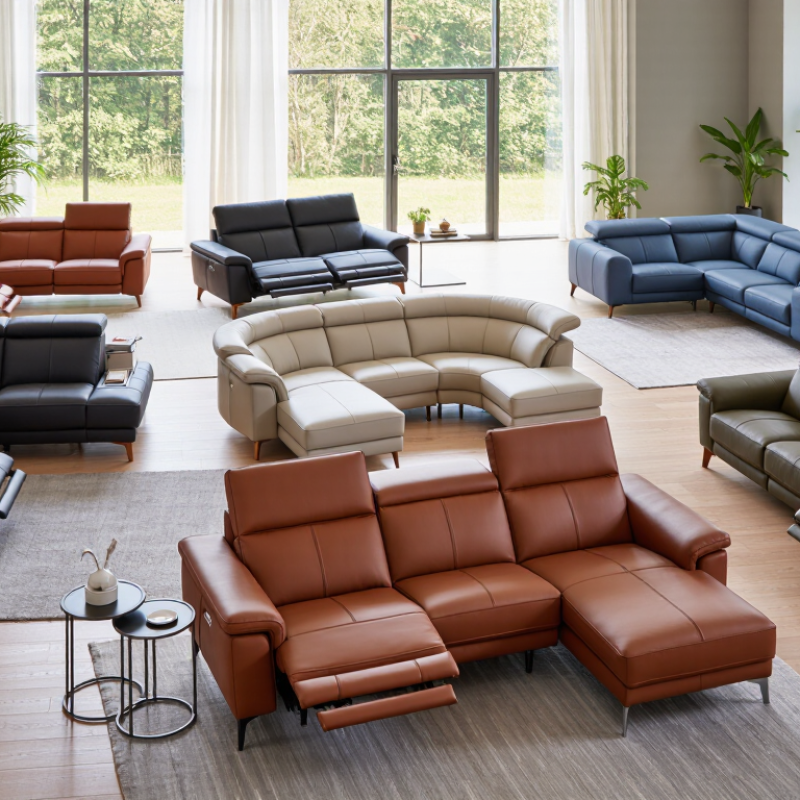
Ten practical types cover most buying briefs: straight-line, apartment-scale modular, L-shaped, chaise-end, corner, U-shaped, pit, curved, semi-circular, and reclining sectionals.

Straight-line and apartment-scale modular designs fit rooms below 25 square meters. Chaise-end and L-shaped models usually seat three to five people. Corner sectionals add five or six seats without crossing the room’s center.

U-shaped and pit layouts support six to ten users, but need wide circulation paths. Curved and semi-circular shapes soften large rooms, while reclining sectionals require extra rear clearance.

CSIL’s World Furniture Outlook 2024 reported an approximate 2% decline in global furniture consumption during 2023. Space-efficient formats therefore deserve serious attention.

Leather also needs practical testing. Sit on the deepest seat, inspect cushion recovery, and measure doorways before ordering. A modular frame can solve difficult access problems.

However, more modules mean more seams and possible alignment issues. This classification is useful, but not perfect. Real rooms resist neat categories.

A six-seat sectional can feel generous in a showroom, then crowded beside a coffee table. Allow at least 70 centimeters for main walkways, though household habits may demand more.

Compare Aniline, Semi-Aniline, and Pigmented Leather Under ISO 11640

Leather sectional buyers often compare aniline, semi-aniline, and pigmented leather by appearance. ISO 11640 adds a practical quality check: resistance to rubbing. It evaluates color change and staining after dry or wet felt contact.

Aniline leather shows natural grain and soft variation. However, its open surface can reveal marks more easily.

Semi-aniline leather adds a light protective finish. It balances visible character with improved daily resistance.

Pigmented leather uses an opaque coating for consistent color and stronger surface protection. It may look less natural.

ISO 11640 results should not be treated as a complete durability guarantee. The test does not measure tearing, abrasion from clothing, sunlight exposure, or long-term conditioning. A sectional passing one rubbing condition may still perform differently in a busy showroom or family room. Ask suppliers for the exact test method, leather color, wet and dry results, and assessment scale. Compare samples under the same lighting. Small differences matter.

Tips: Request a full test report, not only a pass statement. Rub a supplied swatch with a clean white cloth. Check for transfer, gloss changes, and uneven color. Record the leather finish beside the result. Aniline may suit low-use luxury spaces, while pigmented leather often fits demanding contract interiors. Semi-aniline is a compromise, but not a perfect one. That trade-off deserves honest review.

Assess Frame and Cushion Durability Using BIFMA Seating-Test Benchmarks

For global buyers comparing leather sectional types, frame and cushion durability deserve more attention than leather color. ANSI/BIFMA X5.4-2020, the benchmark for lounge and public seating, evaluates structural strength, stability, and repeated-use performance. It is not a complete residential-sofa certification. Still, its testing logic is highly useful. Ask suppliers for test records, load conditions, cycle counts, and failure photos, not only a compliance statement.

Look underneath the upholstery. Kiln-dried hardwood or reinforced engineered wood should show secure joints, corner blocks, and limited frame movement. A sectional passing static loading may still develop noise after years of uneven family use. That weakness is easy to miss. Cushion assessment needs separate evidence. ASTM D3574 is commonly used for flexible polyurethane foam, including compression and fatigue testing, while ASTM D4157 can help evaluate upholstery abrasion. The International Sleep Products Association’s 2024 foam industry data highlights the scale of polyurethane foam use, but foam density and resilience still vary widely between suppliers. A high-density cushion is not automatically comfortable or durable.

The 2024 CSIL World Furniture Outlook places global furniture consumption in the trillion-dollar range, showing why consistent testing matters across export markets. Buyers should compare seat-height loss, permanent indentation, seam slippage, and module-connector strength after testing. Real homes are less controlled than laboratories. That is the uncomfortable part. A technically strong frame can fail when sections are dragged, overloaded, or poorly aligned during installation. A written inspection plan, matched to the intended market, remains essential.

The chart compares common leather sectional configurations using a 0–100 durability screening index. The index combines frame-joint stability, seat-support construction, cushion recovery, and resistance to repeated-use stresses aligned with BIFMA seating-test principles. It is a comparative screening tool, not a BIFMA certification result; formal compliance requires laboratory testing of the finished product.

Verify Global Compliance with REACH’s 3 mg/kg Chromium VI Threshold

Top 10 Leather Sectional Types for Global Buyers

For full-grain, top-grain, aniline, semi-aniline, pigmented, corrected-grain, split, nubuck, suede, and bonded leather, chemical control matters. REACH Annex XVII Entry 47 restricts Chromium VI in leather articles touching skin. The limit is 3 mg/kg, including leather used on sectional sofas. A passing supplier statement is not enough. Each color, finish, and production lot can behave differently.

The European Chemicals Agency’s 2019 enforcement report inspected 3,391 products across 29 countries. It reported an 18% non-compliance rate, showing why paperwork alone can create commercial risk. Chromium VI may appear after tanning or develop during storage, heat exposure, and aging. Buyers should request testing from an ISO/IEC 17025-accredited laboratory. EN ISO 17075-1 or EN ISO 17075-2 methods can support reliable verification. Test results should identify the hide source, batch number, color, and sampling date. Small details matter.

Tips: Test dark and light upholstery separately. Keep sealed samples from every shipment. Check cushions, armrests, and exposed leather surfaces. Ask whether the report covers the finished article, not only raw hides. A supplier may provide excellent documents, yet traceability can still be incomplete. That gap deserves honest review.

Top 10 Leather Sectional Types for Global Buyers - Verify Global Compliance with REACH’s 3 mg/kg Chromium VI Threshold
No. Sectional Type Typical Configuration Common Leather Specification Typical Seating Capacity Best-Fit Use Case Key Buyer Verification Points REACH Chromium VI Check
1 L-Shaped Sectional with Chaise One sofa run joined to a chaise on the left or right side. Top-grain or corrected-grain upholstery leather; split leather may be used on non-contact sides. 3–5 adults Living rooms requiring a defined lounging area with efficient use of corners. Confirm chaise orientation, overall dimensions, door-clearance requirements, cushion construction, and leather coverage. Test skin-contact leather
Request a compliant laboratory report for leather surfaces that contact users.
2 L-Shaped Corner Sectional Two seating sides meet at a fixed or modular corner unit. Full-grain, top-grain, or corrected-grain leather with protective finishing. 4–6 adults Large family rooms, hospitality lounges, and open-plan interiors. Check corner-seat comfort, armrest width, frame stability, abrasion performance, and carton dimensions. REACH Annex XVII Entry 47
Leather parts in contact with skin must not contain Cr(VI) at or above 3 mg/kg of total dry leather weight.
3 U-Shaped Sectional Three connected seating zones create a central conversation area. Top-grain or corrected-grain leather; matching coated leather may be used on selected exterior panels. 6–10 adults Large residential rooms, media rooms, and social seating areas. Verify center support, transport modules, assembly hardware, fire-safety documentation, and floor-loading information. Test all contact surfaces
Include seat fronts, backs, arms, cushions, and other leather areas that may touch skin during normal use.
4 Modular Leather Sectional Separate movable units such as armless chairs, corner units, ottomans, and chaises. Interchangeable top-grain or corrected-grain leather upholstery. 2–10 adults, depending on module count Projects requiring flexible layouts, phased purchasing, or easy replacement of individual units. Confirm connector design, module compatibility, replacement-unit availability, and consistent leather shade across batches. Batch-level verification
Obtain Cr(VI) test results for each relevant leather lot or production batch, not only for the finished frame.
5 Pit Sectional Deep, low-profile seating arranged around a broad central area. Soft top-grain or corrected-grain leather selected for comfort and flexibility. 5–10 adults Media rooms, informal lounges, and relaxed residential interiors. Check seat depth, cushion density, removable-cover options, leather stretch behavior, and cleaning instructions. Skin-contact priority
Test seat cushions, inner arms, back cushions, and other frequently touched leather components against the 3 mg/kg limit.
6 Reclining Leather Sectional Fixed or power-reclining seats combined with a sofa, console, or chaise section. Finished top-grain or corrected-grain leather; synthetic upholstery may be used on selected non-contact areas. 3–6 adults Home theaters, entertainment rooms, and comfort-focused living spaces. Verify motor voltage, plug configuration, mechanism durability, pinch-point safety, remote controls, and spare parts. Leather and electrical review
REACH Cr(VI) testing applies to relevant leather; electrical components require separate market-specific compliance checks.
7 Curved or Crescent Sectional Continuous or segmented curved seating with a rounded front profile. Flexible top-grain or corrected-grain leather suitable for shaped upholstery panels. 4–8 adults Design-led residential interiors, reception areas, and premium hospitality spaces. Confirm radius, installation access, panel matching, seam placement, and uniform color across curved sections. Surface and seam testing
Ensure leather used on curved seating surfaces and exposed seams is covered by the laboratory test sample.
8 Sleeper or Sofa-Bed Sectional Sectional seating incorporating a pull-out, fold-down, or lift-up sleeping mechanism. Top-grain or corrected-grain leather on seating and back surfaces, with possible mixed-material upholstery. 3–6 seated adults; 1–2 sleepers Guest rooms, compact apartments, serviced accommodation, and multifunctional spaces. Check mattress dimensions, opening clearance, mechanism cycle testing, weight limits, and packaging protection. Identify every leather article
Test leather on both seating and sleeping-contact areas where skin contact can reasonably occur.
9 Apartment-Size Sectional Compact two- or three-seat L-shape, chaise, or reversible configuration. Corrected-grain or top-grain leather designed for reduced footprint and efficient upholstery use. 2–4 adults Urban apartments, smaller offices, student housing, and compact hospitality rooms. Verify narrow-door delivery dimensions, reversible chaise hardware, lift access, seat width, and assembly requirements. Supplier documentation
Request a dated test report identifying the leather material, test method, sample origin, and result below 3 mg/kg.
10 Loveseat-Based Sectional Compact sectional built around a two-seat loveseat, corner unit, chaise, or ottoman. Top-grain or corrected-grain leather; material composition should be stated for every upholstered panel. 2–5 adults Small living rooms, executive offices, hotel suites, and waiting areas. Confirm seat width, arm profile, replacement-cushion availability, upholstery composition, and commercial-use rating. Material identification
Verify that leather labels match the tested material and that any coated or split-leather panels are separately assessed when applicable.
Compliance note: Under REACH Annex XVII, Entry 47, leather articles that come into contact with skin must not be placed on the EU/EEA market when any leather part contains chromium VI at a concentration equal to or greater than 3 mg/kg (0.0003% by weight) of the total dry weight of the leather. Buyers should request product-specific, batch-traceable laboratory reports, preferably using EN ISO 17075-1 or EN ISO 17075-2, and confirm additional requirements applicable in the destination market.

Match Each Sectional Type to Shipping Volume, Climate, and Buyer Segment

Top 10 Leather Sectional Types for Global Buyers

Match each sectional type to shipping volume, climate, and buyer segment before ordering. UNCTAD’s Review of Maritime Transport 2023 reports that over 80% of global merchandise trade moves by sea. Therefore, compact apartment sectionals, chaise sectionals, and two-piece L-shaped models can reduce container pressure. These designs suit urban buyers, online retailers, and first-time homeowners. Straight sectionals also stack more efficiently. Not always attractively.

Large U-shaped, curved, and modular sectionals need more cubic space. Modular units separate frames, cushions, and arms, helping buyers manage mixed-container shipments. They fit hospitality projects, premium residences, and furniture showrooms. Reclining and motion sectionals add mechanisms and weight, so pallet planning becomes critical. The World Bank’s 2023 Logistics Performance Index emphasizes reliability, tracking, and delivery timing. Heavy mechanisms can expose weak planning.

Sleeper sectionals target compact homes and rental properties. Chaise lounges appeal to warm-climate buyers who prefer open, relaxed layouts. In humid regions, ventilated warehouses and moisture-resistant packaging deserve attention. The IPCC’s Sixth Assessment Report confirms continued global warming, making heat and humidity practical sourcing concerns. Full-grain, corrected-grain, aniline, semi-aniline, split-leather, and bonded-leather options also serve different budgets. However, labeling can be inconsistent across markets. Buyers should verify leather composition, foam specifications, carton dimensions, and tested load capacity before shipment. A beautiful sectional may still become an expensive mistake when its volume is underestimated.