How to Choose Dining Room Table Sets for Global Buyers?
Choosing dining room table sets for global buyers requires more than comparing styles, prices, and photographs. A table must fit local homes, dining habits, delivery routes, and safety expectations. Room dimensions vary widely across markets. So do household budgets.
Grand View Research valued the global furniture market at approximately USD 677.09 billion in 2023. Its report forecasts continued growth through 2030, supported by urbanization, housing development, and online retail. These trends create opportunity, but they also increase buyer confusion. A polished image cannot reveal table stability, veneer quality, packaging strength, or replacement-part support. That matters when a set travels thousands of kilometers.
The World Bank’s Logistics Performance Index highlights major differences in customs efficiency, infrastructure, and delivery reliability. Global buyers should therefore examine carton protection, assembly instructions, shipment tracking, and after-sales service. The dining room table sets that succeed internationally usually balance visual appeal with measurable performance. Check the chair joints. Measure the doorway. Confirm the tabletop thickness.
This guide will compare materials, sizes, seating capacity, construction, certifications, and regional preferences. It will also consider moisture, temperature changes, and language clarity in product documentation. These details often decide whether a purchase feels dependable or disappointing. No single report explains every dining room. That limitation deserves honesty. Even experienced buyers can overvalue style and underestimate delivery damage. A better decision combines market evidence, supplier verification, practical measurements, and careful questions before payment.
Measure Space with 60 cm per Diner and 90 cm Circulation Clearance
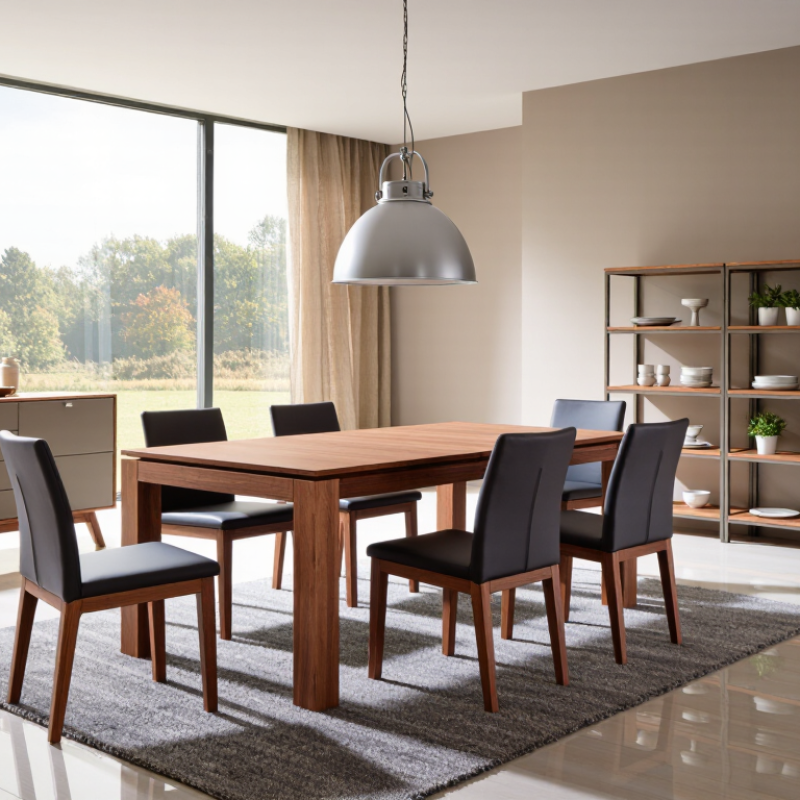
A dining table set should fit the room before it matches a catalog photograph. Measure the usable floor, not the advertised room size. Allow at least 60 cm of table edge for each diner. Four diners therefore need about 240 cm of seating perimeter, though table shape changes the calculation.
A rectangular table may seat six efficiently, while a round table needs more surrounding space. Keep 90 cm between the table edge and walls, cabinets, or other furniture. This clearance lets someone pull out a chair without blocking movement.
Door swings deserve attention.
Use a tape measure and mark the proposed table with painter’s tape. Place the chairs inside the outline. Walk around it with a tray. This simple test reveals awkward corners quickly.
In homes with frequent entertaining, 90 cm may be only a starting point. A passage used by several people can need 105 cm or more. I have seen layouts that met the numbers but still felt cramped because chair backs were bulky.
The rule is useful, not absolute. Check metric conversions, delivery access, and local room practices before ordering. A compact set may look efficient online, yet its legs can reduce knee space.
Re-measure after adding flooring, rugs, or sideboards. Small errors become expensive. Leave the measurements visible overnight.
Select Table Height Near the 74–76 cm Industry Standard for Comfort
For global buyers, dining table height deserves more attention than surface style. A practical target is 74–76 cm from floor to tabletop. This range matches common adult dining furniture dimensions across many markets. BIFMA G1-2013 also treats work-surface height as an ergonomic fit issue, rather than a fixed universal measurement. Dining comfort follows the same principle.
Check the chair and table as a pair. A chair seat height near 45–48 cm usually supports a comfortable relationship with a 74–76 cm tabletop. The user should place both feet flat on the floor. Knees should slide beneath the apron without touching the frame. EN 12521:2015 focuses on domestic table safety and stability, but its requirements do not guarantee personal comfort. That difference matters.
Anthropometric data explains why one measurement cannot suit everyone. The ANSUR II Anthropometric Survey records wide variation in seated elbow height among adults. DIN 33402-2 similarly uses percentile ranges instead of one “average” body. Buyers serving mixed households should test several body types. Leave enough legroom, ideally around 60 cm in width per person. A 180 cm table may seat six people, but thick legs can reduce usable space. I have seen attractive sets feel cramped after one meal. The 74–76 cm range is a sound starting point, not a promise. Test with real chairs, plates, and elbows before ordering.
Compare Materials Through EN 12521 Safety Criteria and FSC Certification
For global buyers, dining room table sets should be assessed beyond appearance and price. Material choice affects stability, durability, maintenance, and responsible sourcing.
EN 12521 focuses on the safety, strength, and durability of domestic tables. It addresses stability, structural strength, and resistance to repeated use. Ask suppliers for test reports, the test date, and the exact table configuration tested. A passing report is useful. It does not replace careful inspection. Check joints, leg fixings, sharp edges, and glass contact points. A table that survives a laboratory load may still feel unstable on an uneven floor.
FSC certification supports responsible forest management and traceability. It can help buyers verify that wood comes from controlled, certified sources. Request the certificate number and confirm its scope, especially for mixed wood, veneer, or composite components. Do not assume every part is certified. A small unverified panel can change the claim. I once reviewed a set with impressive paperwork, but the extension leaf used different materials. That detail mattered. Buyers should compare the certified percentage, finish, moisture resistance, and repair options. Wood grain may vary. Minor variation is normal, but unclear documentation deserves another question.
How to Choose Dining Room Table Sets for Global Buyers?
This screening chart compares common table materials through EN 12521 safety assessment relevance and FSC certification relevance.
A value of 1 means the route is directly relevant: EN 12521 can be used to assess domestic tables regardless of the main material, while FSC certification applies to forest-based materials when certified sourcing and chain-of-custody requirements are met. The chart is a purchasing guide, not a certification result.
Verify Export Costs with UN Comtrade HS 9403 Data and Incoterms
Global buyers should treat HS 9403 as a starting point, not a perfect product label.
UN Comtrade classifies dining tables within broader furniture categories. The code can also include other furniture and parts. Compare export value, quantity, and unit value by supplying country.
A sharp unit-price gap deserves investigation.
It may reflect materials, packaging, or reporting differences.
Incoterms 2020 then convert trade data into a realistic buying cost.
Under FOB, the seller generally loads the goods at the named port. The buyer pays ocean freight, insurance, import clearance, and inland delivery.
Under CIF, the seller arranges freight and minimum insurance, but destination charges can remain unclear.
Request a quotation showing the named place, carton count, gross weight, and every local surcharge.
The World Bank’s 2023 Logistics Performance Index covered 139 economies and surveyed 4,090 trade professionals.
Its results show that border handling and shipment reliability vary widely. That matters for heavy dining sets with fragile surfaces.
I would test two routes, not one.
Compare a recent UN Comtrade benchmark with forwarder quotations and port fees.
The method is useful, but imperfect. HS 9403 does not isolate dining tables, and freight rates change quickly. Some quotations also hide destination handling costs. Ask for written assumptions before comparing suppliers.